The Air Jordan 10 Retro Doernbecher, style 636214-066, is more than a black-and-red variation on a familiar model. Daniel Pena's 2013 design uses a personal monogram, glossy patterning and a tire-tread reference to make an established Jordan silhouette carry an individual story.
The shoe released on November 23, 2013 at a reported $170 retail price as part of Doernbecher Freestyle. Understanding that program is essential to reading the design accurately. Its details originated in a patient-led creative project, rather than in a generic color brief or an invented connection to a game Michael Jordan played.
The program places young designers at the center
OHSU's own history dates Doernbecher Freestyle to 2004. The initiative pairs young hospital patients with Nike designers and developers to create footwear and apparel that tell their stories and support the hospital. Daniel's AJ10 belongs to the 2013 collection. This framework makes authorship central: the details are meaningful because they express a particular designer's interests, not simply because a famous sneaker model carries them.
It is equally important to distinguish the original charitable program from a later retail or resale transaction. The sources document the benefit associated with the Freestyle initiative; they do not establish that every subsequent sale of a surviving pair sends money to the hospital. This article describes the historical collaboration and Daniel's design. It does not make an unsupported donation claim about the current store listing.
A personal emblem and a BMX reference
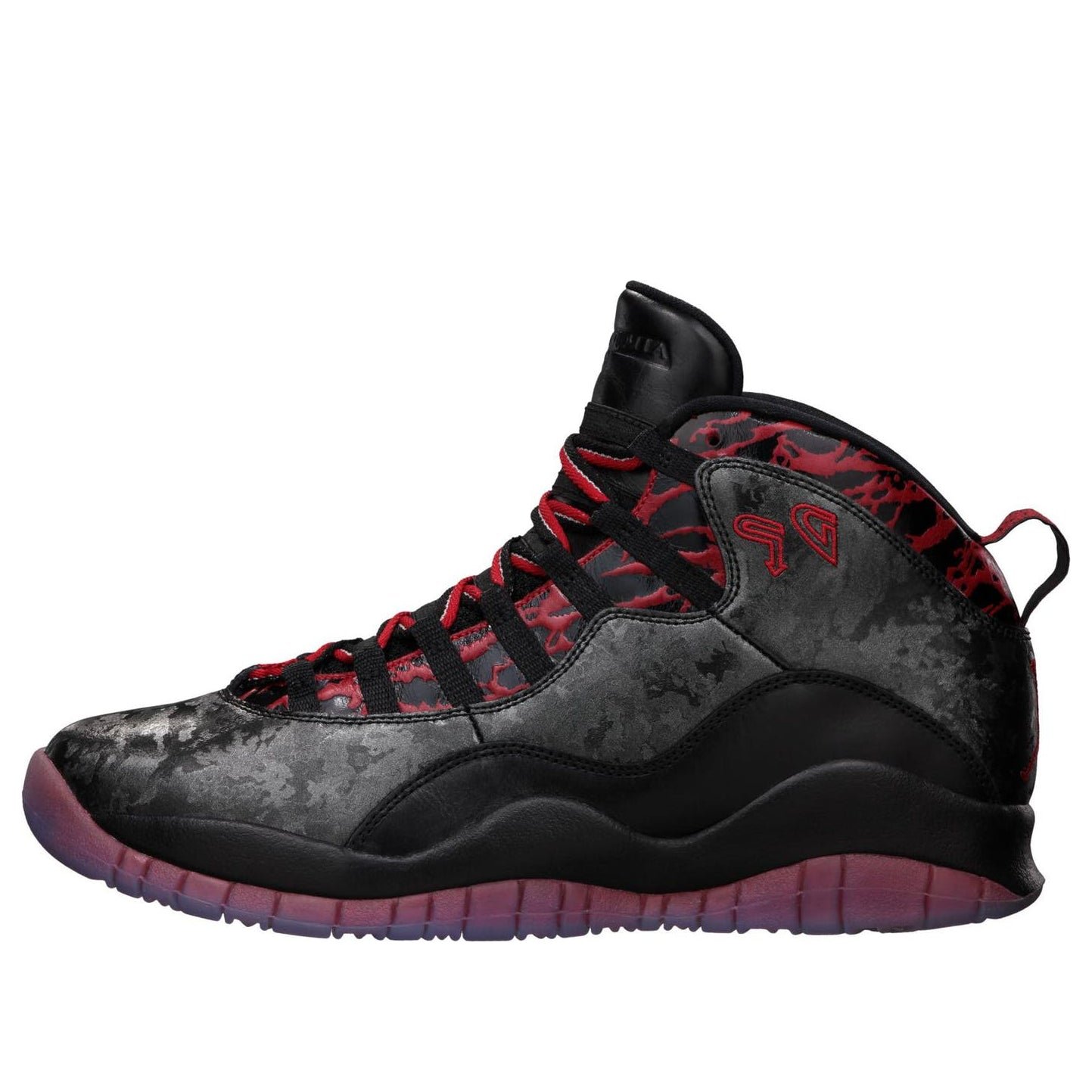
GOAT's archive identifies the DP initials near the ankle and a red tire-tread detail at the heel inspired by Daniel's BMX interest. Contemporary Sneaker News coverage confirms his authorship and the Black/Gym Red product code. These are useful, verifiable anchors for interpretation. The monogram changes the collar from a standard branding location into a personal signature, while the heel introduces a reference from outside basketball.
The store image shows how those ideas fit together. Red lacing details and trim emerge from a dark, patterned upper, while the translucent-looking lower edge introduces purple and red tones. The surface is not uniformly matte: areas of sheen make the camouflage-like pattern more visible as the light changes. The result feels deliberately layered, with the broad black shape establishing the silhouette and smaller red elements supplying the points of attention.
The AJ10 provides a comparatively clean canvas
Nike's archive credits Tinker Hatfield with the original Air Jordan 10 and explains that it was developed during Jordan's time away from basketball before accompanying his mid-1990s return. That history belongs to the underlying model. Daniel's contribution is a later interpretation of it, bringing his own graphics and color choices to an outline whose relatively continuous side panels allow surface treatment to remain highly visible.
Unlike a design dominated by a large lateral Swoosh or a prominent external wing, the AJ10 leaves substantial room for texture and pattern. On this edition, that space becomes the main stage for the darker graphics. The eye then moves upward to the initials and backward to the heel. This sequence is a visual reading of the photographed shoe, not a claim that every small motif has a documented symbolic meaning.
The 2013 launch and the surviving product
Sneaker News's November 21 official-image report gives a November 23, 2013 launch and $170 retail, matching the earlier Nice Kicks collection price announcement and the product archive. The agreement is useful because early collection previews can preserve provisional dates. For this specific AJ10, the later launch records provide a consistent date and code. They also distinguish it from the other shoes in the same Freestyle collection.
A current pair should be examined for the condition of its patterned upper, ankle emblem, heel detail and sole. Age, storage and wear can affect those components differently, and a historical photograph cannot establish their present state. The release's significance does not depend on inventing rarity statistics or resale gains. Its strongest story is already documented: a young designer used a recognizable basketball shoe to express interests that were his own, within a program built around creative participation.
Release details at a glance
- Style code: 636214-066
- Designer of this edition: Daniel Pena
- Program: 2013 Doernbecher Freestyle
- Colorway: Black / Gym Red
- Release date: November 23, 2013
- Original reported retail: $170
- Identifying details: DP ankle emblem, patterned upper and BMX-inspired heel treatment
Daniel's Doernbecher AJ10 is best remembered through its authorship. Its personal details transform a familiar retro without obscuring its outline, preserving a specific example of how the Freestyle program gives young designers room to shape the story themselves.
Research note: Historical facts were checked against the sources below. Visual observations refer to the linked product image. Archive disagreements are identified in the article; current price, condition and availability belong to the product listing. Sources: OHSU: primary history of Doernbecher Freestyle; Nike: original Air Jordan 10 history; Sneaker News: November 2013 official-image release report; Nice Kicks: original collection pricing and dates; GOAT: exact product and personal design details.